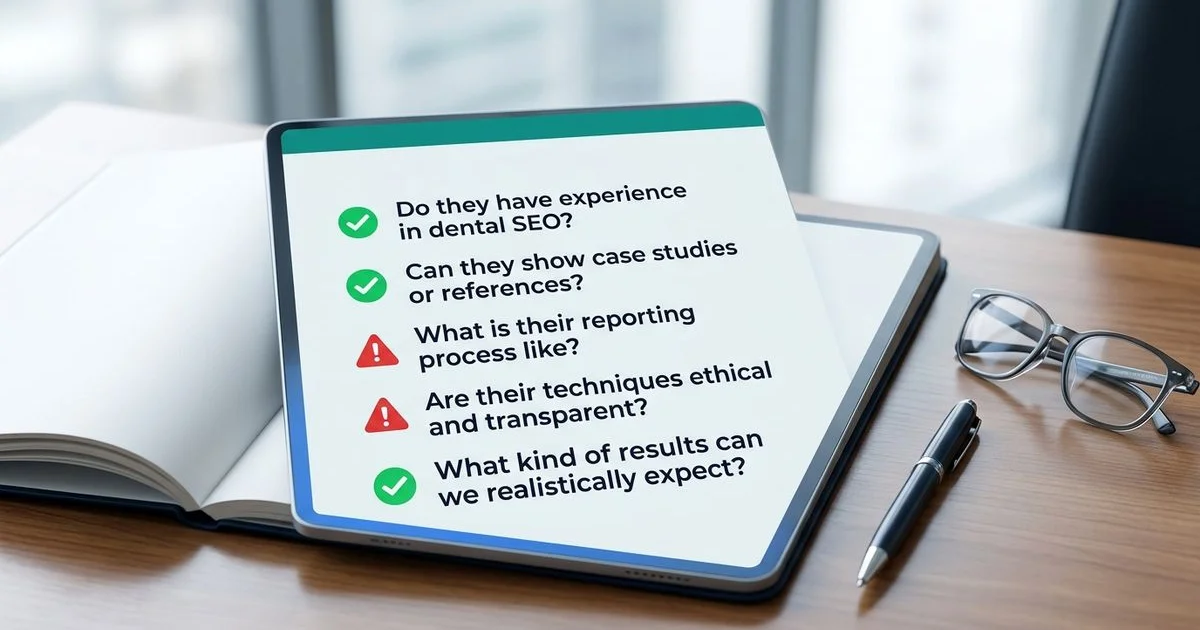
We see it happen constantly in the digital marketing space when practices try to figure out how to choose a dental SEO company.
A practice invests heavily in growth, only to realize months later they bought a generic package disguised as a specialized service — instead of true dental SEO built only for practices. This is a frustrating reality when you consider that a 2023 industry study found 77 percent of prospective US patients now begin their search for a dentist on Google.
Our team, operating as a professional service firm, knows that search visibility is the exact dividing line between stagnant schedules and steady new patient volume.
Finding the right partner requires knowing exactly what to look for behind the sales pitch. You need a clear way to cut through the noise and identify a firm that actually understands healthcare marketing.
We are going to break down the specific questions you need to ask, the warning signs that signal trouble, and why true specialization matters.
Questions to ask when deciding how to choose a dental SEO company
You must evaluate potential partners using strict criteria to separate actual experts from basic marketing vendors. Asking the right questions upfront prevents costly mistakes down the line.
”Do you work only with dental practices?”
Our firm recommends making specialization a mandatory requirement. Generalist agencies handle dentistry as one of dozens of industries.
This lack of focus means slower response times, weaker clinical knowledge, and generic content. We find that a dedicated focus allows a provider to anticipate compliance needs and patient search behaviors immediately.
You will not have to waste time explaining the difference between an endodontist and a periodontist. The best dental SEO agency already knows exactly what converts site visitors into booked appointments.
”What’s in your monthly deliverable, itemized?”
Our standard practice is to provide a highly specific list of monthly tasks and outputs. A legitimate agency can tell you exactly how many blog posts, Google Business Profile updates, and citations you will receive.
Vague answers like ongoing optimization usually mask thin, low-effort work. We always tell practice owners to align these deliverables with their financial investment.
The average cost for legitimate US dental search engine optimization in 2025 ranges from $1,500 for a solo clinic to over $8,000 for multi-location groups. Your itemized list should justify that specific price tag.
”What does your audit cover?”
Our preferred approach involves a comprehensive manual review combined with actual search data. A 30-point dental marketing company checklist using real Google Search Console metrics is meaningfully different from a one-click automated scan.
Recent 2026 industry evaluations reveal that 9 out of 10 marketing agencies fail to define a specific audit methodology on their websites. We suggest asking to see a sample audit document before signing anything.
This document should detail header tag architecture, crawlability issues, and local content gaps. An automated export from a tool like SEMrush is simply not a true strategy audit.
”How do you handle reviews?”
Our protocols treat patient privacy as the absolute highest priority during reputation management. HIPAA compliance matters immensely when replying to online feedback.
An agency that cannot articulate how their review-generation workflow stays compliant probably puts your license at risk. We constantly remind clients that acknowledging a patient’s medical visit online is a direct privacy violation.
The American Dental Association notes that 39 percent of dentists actually avoid responding to reviews entirely due to HIPAA fears. A competent firm provides safe, pre-approved response templates that keep your practice protected.
”Can you guarantee rankings?”
Our immediate response to this question is that it is essentially a trick. No reputable digital marketer can guarantee specific positions on Google. Search algorithms change constantly, making absolute promises impossible.
We view any agency offering guaranteed first-page placement as either lying or utilizing risky tactics.
Those risky methods will inevitably lead to a manual penalty that drops your site completely from the index. You should look for realistic growth projections based on historical data instead of empty promises.
Red flags to avoid
Our team has audited hundreds of failing campaigns to identify the most common warning signs. You need to recognize these poor practices before they damage your local search presence. The table below highlights the stark contrast between a professional partner and a low-quality vendor.
| Feature | Red Flag Agency | Legitimate Agency |
|---|---|---|
| Pricing Model | $99 to $300 per month packages | $1,500+ based on clinic scope |
| Audit Style | Automated PDF software export | Manual 30-point data analysis |
| Contract Terms | 12 to 24 month strict lock-in | Month-to-month or flexible |
| Review Strategy | Ignores strict HIPAA rules | Uses safe compliant templates |
Our firm uses these exact criteria when taking over campaigns from other providers.
Guaranteed first-page rankings
The core algorithm at Google strictly prohibits absolute ranking guarantees. Search engines update their ranking factors thousands of times per year.
Our experience shows that promises here almost always mean risky tactics. These aggressive shortcuts might create a temporary bump in traffic.
Those same methods will inevitably result in severe search penalties.
One-click automated audits
We frequently see proposals padded with generic, computer-generated reports. These automated scans miss the technical issues that actually move rankings. A software crawler cannot accurately assess local search intent or nuanced content gaps.
Our analysts perform manual reviews because real audits require human context and actual search data.
You need a strategist to review header tag problems and specific local competition. Automated PDF exports simply do not provide that necessary level of insight.
Long lock-in contracts
Our agency believes that quality work naturally earns ongoing client engagement. Firms that require 12 to 24 month contracts with massive cancellation fees are protecting themselves. They use these legal agreements to prevent churn driven by poor performance.
We reviewed a 2026 market study showing that zero out of ten prominent dental agencies openly published their contract length terms online.
This lack of transparency is a massive warning sign. You should demand a month-to-month agreement or a short initial proof-of-concept phase.
Bargain-basement pricing
Our pricing discussions always center on the actual cost of skilled labor in the United States. A $99 per month package is paying for autopost software and scraped citations. That low fee does not cover the cost of a real human doing strategic work.
We warn practices that the cleanup for cheap digital marketing always costs more than the initial savings.
Those low-tier services often create duplicate directory listings on platforms like Yext that take months to untangle. You should expect to pay a fair market rate for professional, specialized growth services.
Vague reporting
Our monthly review meetings focus exclusively on tangible, measurable business outcomes. Saying the strategy is working while handing over a generic dashboard is not real reporting. You need to see exactly how your investment translates into booked appointments.
We provide itemized monthly reports detailing the exact links built, posts published, and citations placed.
This level of accountability is the standard for any professional firm. If your current vendor hides behind vanity metrics, it is time to find a new partner.
Why dental specialization matters
Our analysts track the specific dynamics of the healthcare search landscape every single day. The dental search environment has its own unique set of rules and patient behaviors. Patients search for specific procedures, acute symptoms, and immediate emergency care with high frequency.
We optimize for these distinct technical requirements that separate clinical marketing from standard retail operations:
- Mobile search dominance for urgent care terms.
- Healthcare-specific Google Business Profile attributes.
- Medical citation directories like Healthgrades and CareDash.
A specialized agency already understands the regulatory landscape and the patient journey. A generalist learns these critical lessons on your dime, assuming they bother to learn them at all.
Our team prioritizes specialization because it is the most reliable way to generate a return on your marketing investment. You simply cannot afford to be a test case for an inexperienced vendor. Choosing an expert team ensures your practice grows securely and steadily.
We are ready to show you exactly how a proper technical evaluation should look. For more on the specific depth a good audit covers, see our breakdown on a free vs paid dental SEO audit.
You can skip the comparison entirely and request a 30-point audit directly from our team.
Our analysts will reveal exactly what depth we deliver and how to choose a dental SEO company confidently. Take that next step today to secure your local market share.
Stop letting generic marketing hold your clinical growth back.