We know exactly how frustrating it feels to watch a competitor down the street claim the top spot on Google Maps. Local search completely changed in 2026, making a generic seo audit report dentist template virtually useless. Patients are calling clinics directly from search results without ever loading a webpage.
Our dental seo audit report delivers the exact blueprint you need to capture those missing calls.
A proper assessment gives you a clear understanding of your site health, a ranked list of fixes, and total confidence about who should execute them. The following sections review the exact deliverables you receive.
What’s in a dental SEO audit report
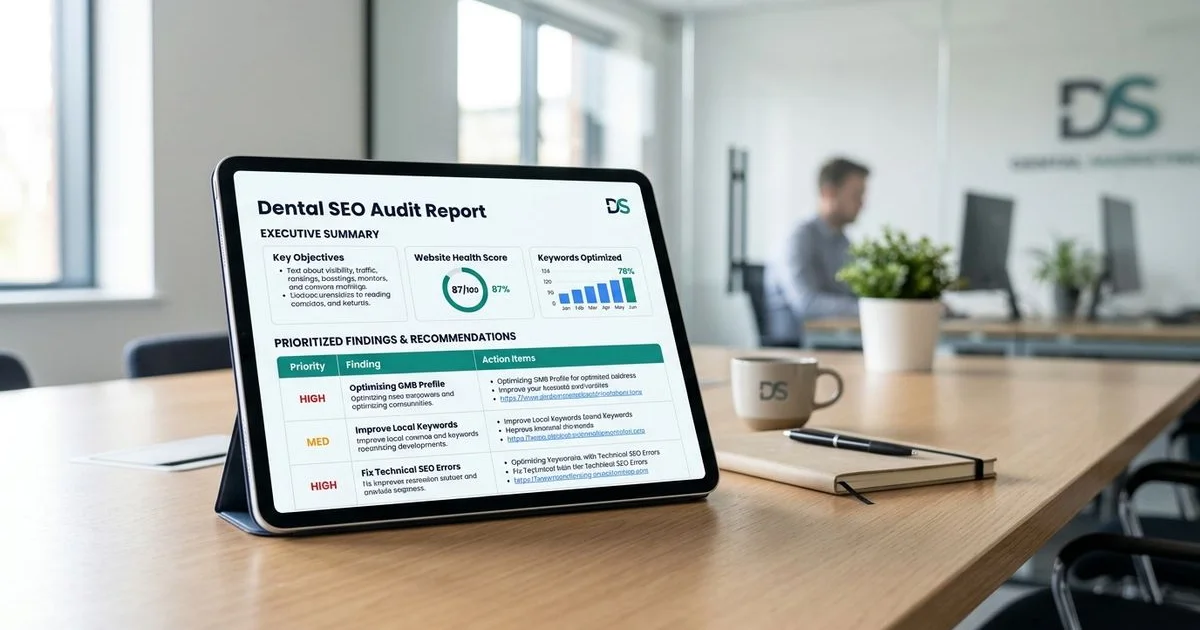
We provide a comprehensive document covering technical performance, local map visibility, on-page content, and backlink authority. The executive summary gives a non-technical reader a clear health score in five minutes. The top three issues affecting rankings and the best quick wins are highlighted right on the first page.
Our technical SEO findings document crawlability, indexation, and mobile usability with exact severity ratings. Page speed is tested directly against the strict 2026 Core Web Vitals thresholds. These three specific performance targets dictate how Google evaluates your site speed:
| Metric | What It Measures | 2026 Passing Score |
|---|---|---|
| LCP | Time for the largest element to load | Under 2.5 seconds |
| INP | Page response time to a click | Under 200 milliseconds |
| CLS | Visual layout shift during load | Under 0.1 |
We evaluate your authority and backlink profile against top local competitors. Finding editorial links from health publications is the most efficient way to close the authority gap. The on-page analysis measures keyword targeting to ensure high-value terms have dedicated content depth.
Our local SEO review focuses heavily on your Google Business Profile and NAP consistency across citations. Map Pack visibility is charted using a Geogrid heatmap to show exactly where your practice ranks. The Search Console diagnostics section reveals real search behavior across several metrics:
- Queries gaining or losing impressions
- Pages with high visibility but low click-through rates
- Coverage errors and ranking changes over time
We consolidate every finding into a single prioritized action plan. Highest expected impact tasks are listed first. Effort estimates are provided so you can schedule development resources effectively.
A sample finding
Our reports avoid vague advice and instead give you exact, undeniable proof of what is broken. A 30-point dental audit deliverable looks at specific technical failures holding back your patient acquisition. To give you a sense of what depth looks like, here is a real example from a recent client:
Finding: Service page H1 hierarchy broken on 4 of 5 service pages.
Evidence: Pages /teeth-whitening/, /dental-implants/, /invisalign/, /pediatric-dentistry/ each use H1 tags on decorative section titles, with the actual page title using H2. Only /emergency-dental/ uses correct hierarchy.
Impact: Diluted topic signals; Google reads the decorative H1 as the page’s primary topic. Likely contributing to weaker rankings on each page’s target keyword.
Fix priority: HIGH. Standard development time: 2-4 hours.
We document every issue like this so you have specific, evidenced, and ranked tasks. Actionable data replaces guesswork, showing exactly why a service page is losing traffic. Development time estimates are included to prevent agencies from overcharging you for quick fixes.
Turnaround
Our standard delivery time for a complete assessment is three to five business days from data access. The average industry wait time in the US often stretches to two weeks, but speed matters when you are losing patients. A strategy walkthrough call is typically scheduled for the same week you receive the document.
We prioritize this fast turnaround to help you implement changes before the next Google core update. Average US patient acquisition costs continue to rise above $300, making swift technical improvements essential. Prompt implementation of these fixes directly impacts how fast you start capturing local search traffic.
What happens after
Our team schedules a walkthrough call to discuss findings, prioritization, and the action plan. You receive the complete dental seo audit report and have total freedom to choose your next steps. After the review, three paths are commonly taken by practice owners:
- Path 1: Internal implementation. Your developer or in-house marketing team executes the action plan at your own pace.
- Path 2: Agency handover. An existing marketing agency gets a clear roadmap and a strict benchmark for accountability.
- Path 3: Monthly engagement. Most practices choose this route because the findings align with standard monthly packages, and the fee is credited toward the first month.
We require no obligation either way. Request your free 30-point audit to see exactly what depth is delivered, or read more about our dental SEO audit service. For context on what a “real” analysis covers, see what is a dental website SEO audit.