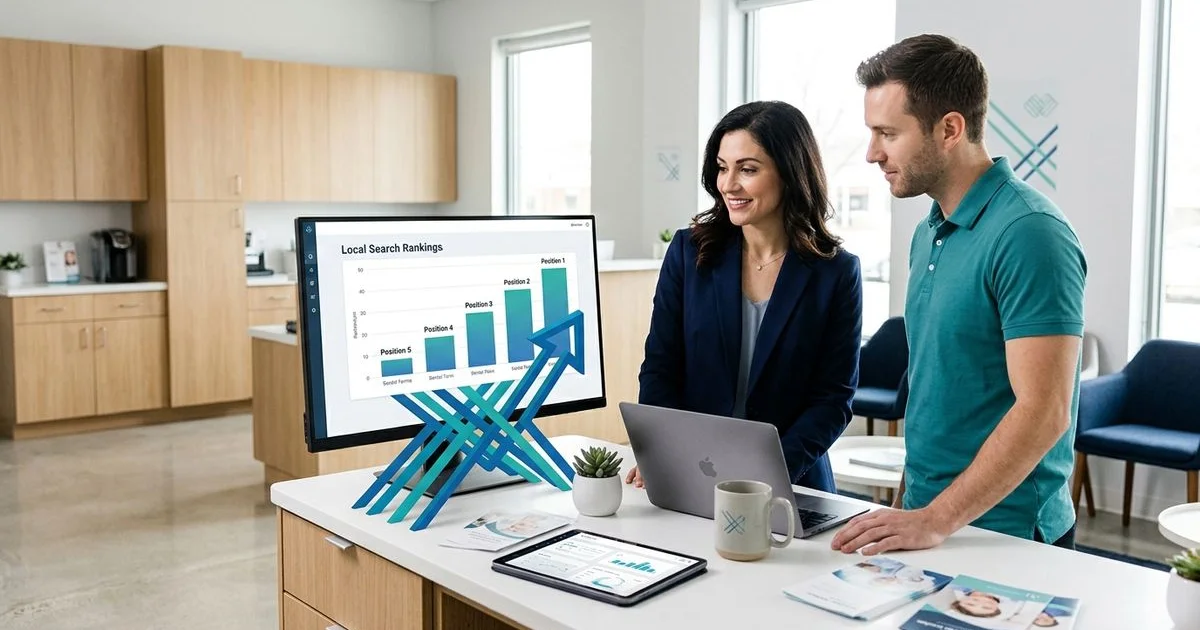
We talk to practice owners every day who are frustrated with their local search results. They invest heavily in a beautiful website, yet they still watch competitors claim the top spots in Google Maps. Our team sees this exact scenario constantly across the U.S. dental market.
The dividing line between a standard organic listing and a highly visible Map Pack presence usually comes down to your backlink profile.
Backlinks affect dental local rankings very differently than they affect standard organic rankings. Understanding this distinction helps practice owners spend their budget where it actually moves the needle. Let’s look at the data, what it is actually telling us, and explore practical ways to respond.
How backlinks flow into local rankings
We know that Google’s local algorithm weighs three primary factors to determine placement: relevance, distance, and prominence. Practice owners constantly ask us, do backlinks help map pack visibility? The answer is a definitive yes.
Relevance and distance are mostly tied to your physical address and website content. Prominence, however, relies heavily on external signals like backlinks. Backlinks act as a vote of confidence, giving Google a clear read on how trusted your practice is across the web.
Pro Tip: While you cannot change your clinic’s physical distance from a searcher, you have direct control over your prominence. Building a strong backlink profile is the most effective way to outrank a closer competitor.
A practice with strong domain authority has much higher prominence signals. This authority is built through quality, locally relevant backlinks over time. Higher prominence means Google trusts the clinic more, which translates directly to better Map Pack visibility for queries in your geographic area. The 2026 Whitespark Local Search Ranking Factors study confirms that while Google Business Profile signals are the foundation, prominence factors like inbound links are often the tiebreakers in competitive US markets.
Our link building experts track this indirect but very real chain reaction every month. Quality backlinks feed into domain authority, which boosts prominence, and finally improves your Map Pack rank. You will see this effect most clearly when fighting for competitive keywords like “Invisalign dentist near me.”
Authority and trust signals
Every high-quality backlink adds to your domain’s overall authority score. Tools like Ahrefs measure this as Domain Rating, or DR, on a scale from zero to one hundred.
Our team routinely sees the massive difference a DR bump makes for local map performance in dense US cities. Higher DR correlates with:
- Better rankings for competitive keywords like dental implants or veneers.
- More resilience to core algorithm updates.
- Faster ranking timelines for new pages and content.
- Stronger Map Pack performance in highly competitive markets.
A 2025 study from BrightLocal found that websites with 20 or more high-quality local backlinks rank in the Map Pack 83% more often than those without. This data proves that while you cannot measure prominence directly through a Google dashboard, you can track domain authority and backlink quality as reliable indicators. They correlate strongly with actual local SEO outcomes.
We strongly advise against buying cheap link packages from unvetted domains, as spammy links actively harm your local visibility and trigger algorithmic flags. A single link from an established US dental association provides more ranking power than fifty links from random, unrelated directories. Search engines want to see validation from real, authoritative organizations.
Local relevance matters too
A backlink from a real local source carries significantly more weight for map rankings than a generic, national backlink. Examples include community organizations, local news sites like Patch.com, or a regional dental society.
Local backlinks signal both topical authority and geographic relevance. This creates a double benefit that directly feeds the Map Pack algorithm.
Our strategy heavily prioritizes relevance-first outreach rather than mass placement. A handful of locally relevant, authoritative links will always outperform dozens of random placements. Google’s AI Overviews also rely on these highly localized signals. The 2026 Whitespark survey highlighted that unstructured citations, like brand mentions on a neighborhood blog, are a top factor for appearing in AI-driven local results.
Here is a look at the most valuable types of local links to pursue:
- Community Sponsorships: Supporting a local Little League team or a 5K charity run usually earns a link from the event website.
- Local Chamber of Commerce: These memberships provide a highly trusted, geographically specific backlink.
- Regional News Outlets: Offering expert commentary on dental health trends to local journalists builds immense credibility.
- Local Vendor Testimonials: Writing a positive review for your IT provider or commercial cleaner can often secure a backlink on their site.
We encourage practices to look at their existing real-world relationships first. Many clinic owners already sponsor local events but simply forget to ask the organizer for a website link.
Anchor text safety
Anchor text is the clickable phrasing of a link, and it serves as one of Google’s strongest signals for link manipulation detection. Over-optimized anchors look incredibly unnatural to search engine crawlers.
If every single backlink says “best Frisco dentist” or “Plano dental SEO,” you will almost certainly trigger an algorithmic penalty.
Our internal data shows that a natural anchor text profile is essential for long-term safety. You must keep your link profile balanced to avoid the spam filters. A healthy, natural anchor text distribution looks roughly like this:
| Anchor Text Type | Target Distribution | Example Phrase |
|---|---|---|
| Brand Mentions | ~40% | “seo service for dentists” or clinic name |
| Generic Phrases | ~20% | “this article,” “here,” or “their service” |
| Partial-Match | ~20% | “local dental care options” |
| Exact-Match | ~10% | “best pediatric dentist in Boston” |
| Naked Links | ~10% | “https://www.yourwebsite.com” |
We always advise sticking close to that specific distribution. If you drift too far from these percentages, your risk rises significantly. Google reads a balanced profile as an organic endorsement from the local community.
The realistic impact
A consistent monthly link-building program typically delivers measurable improvement within a few business quarters. We recommend a baseline strategy of acquiring 2 quality guest posts and 10 citations per month.
Sustaining this exact pace for 6 to 12 months creates a massive shift in local visibility. You can expect to see specific gains across several key performance indicators:
- Domain authority increases, usually resulting in 5 to 15 point DR gains.
- Organic rankings rise steadily for target service keywords.
- Map Pack stability improves dramatically in competitive markets.
- Content visibility increases rapidly for newly published pages.
It is important to set realistic timeline expectations. The first 90 days serve strictly to build the foundation and signal activity to Google. Months 4 through 12 are when you actually experience the compounding ranking impact that drives new patient calls.
Let our team handle this entire process for you. Our dental link building service handles the outreach and placement monthly with transparent reporting. To see your current backlink profile and competitive gap, you can request a free 30-point audit.
For a detailed comparison of different link types, see our guide covering guest posts vs citations for dental SEO.