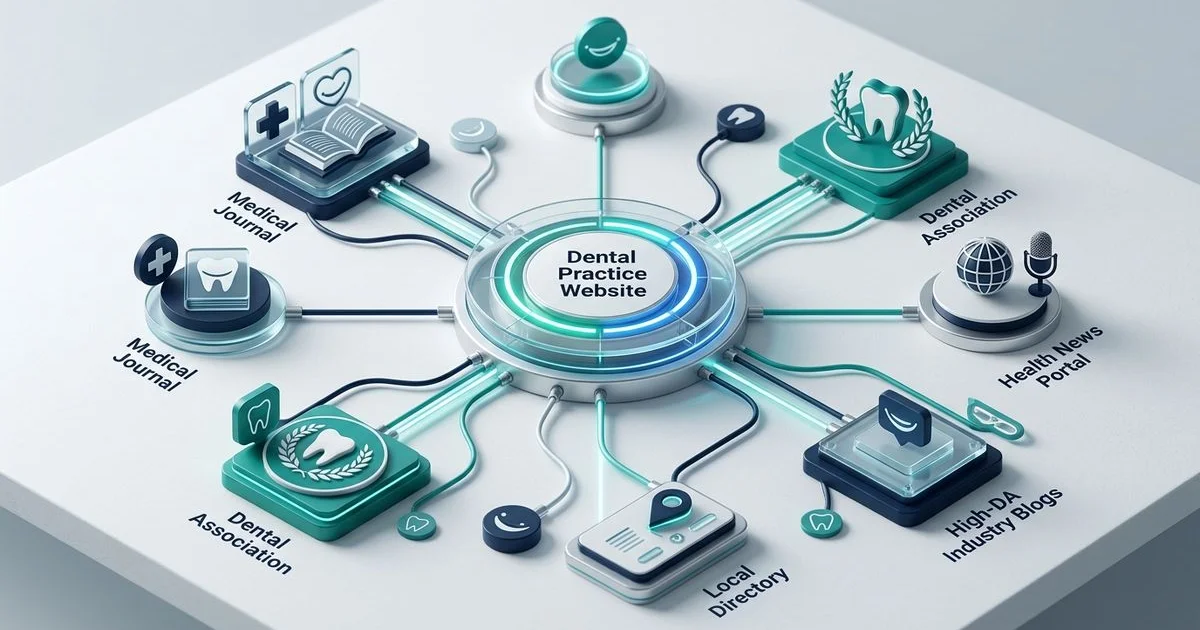
We know the frustration of watching a technically perfect website stall on page two of Google. That plateau usually happens because off-page SEO is missing from the marketing strategy.
Off page SEO for dentists is everything that happens away from your website that affects how Google ranks your practice.
For US dental practices, this process comes down to two main activities: building authority through backlinks and establishing local trust through citations. We have watched countless clinics optimize their pages to perfection, only to lose out to competitors with stronger external signals.
A 2026 Whitespark study shows that AI search overviews now appear in 68% of local business queries. Off-site presence heavily dictates this new visibility. We will break down the specific data points that matter most right now and explore practical ways to respond.
Off page SEO for dentists defined
Off-page SEO covers all the actions taken outside of your website that impact your search engine rankings. Search engines need external proof that your clinic is legitimate, popular, and trusted by the community.
To understand the difference, look at the dividing line between internal and external factors:
- On-page SEO: Covers everything you control directly on your site, such as service content, URL structure, page speed, and schema markup.
- Off-page SEO: Covers everything else, including who links to your domain, what local directories say about you, and how your business identity appears across the web.
Google uses these off-page signals to evaluate prominence and authority. Prominence measures how well-known your practice is, while authority checks whether other medical sources vouch for you. Both factors heavily influence rankings, especially in local search.
Data from BrightLocal’s 2026 Local Search Ranking Factors report reveals that reviews and external citations now account for roughly 24% of the local search algorithm. We use this data to prioritize off-site trust signals immediately. You need external websites to validate your clinic’s identity before search algorithms will reward you.
Links vs citations
Links and citations are entirely different off-page assets. Links are clickable references from one website to another, while citations are simple mentions of your business name, address, and phone number across the internet.
Both elements matter for a complete strategy. Links drive domain authority, while citations support local geographic relevance. Neither replaces the other.
Links are clickable pathways from one site to another. When a state dental association website links to your practice, that acts as a backlink. Backlinks pass “link equity” or authority, and Google reads each one as a distinct vote of trust.
Citations are mentions of your business name, address, and phone number on directory sites. These listings may or may not include a hyperlink. Their primary role is verifying your business identity across the web and supporting local trust signals.
We see many practices confuse the value of general directories versus industry-specific ones. A basic listing on a random directory clone does very little in 2026. However, highly relevant healthcare platforms carry immense weight.
Here is a quick comparison of where to focus your citation efforts in the US:
| Citation Type | Primary Purpose | Top US Examples |
|---|---|---|
| Healthcare Directories | Verify medical credentials and allow patient booking. | Zocdoc, Healthgrades, CareDash |
| Industry Associations | Build deep topical authority and professional trust. | American Dental Association (ADA), local dental societies |
| Local Business Data | Establish geographic relevance for map packs. | Yelp, Google Business Profile, Yellow Pages |
A smart insider tip is to connect your profiles where possible. For example, Zocdoc now automatically syndicates availability with Healthgrades. We help clients set up this single integration to capture demand across two of the largest US patient directories at once.
What good dental links look like
A high-quality dental backlink acts as an editorial vote of confidence from a relevant, trusted source. To move the needle in search results, a link must appear naturally within credible content.
Not all links pass the same amount of equity. We evaluate every potential backlink against a strict set of quality standards to ensure it actually helps your ranking profile.
Core Traits of a Powerful Backlink
A truly valuable dental backlink usually features the following characteristics:
- Topical relevance: The link comes from a site related to dentistry, healthcare, local business, or the specific geographic region you serve.
- Real authority: The linking site itself possesses strong authority signals. A domain rating (DR) of 30+ on tools like Ahrefs is a useful baseline, provided real organic traffic backs up that metric.
- Natural anchor text: The clickable link text reads organically in context. It is never stuffed with exact-match keywords like “best dentist in Chicago”.
- Editorial placement: The link appears directly in the body content of an article, rather than buried in a sidebar, footer, or an explicitly marked “sponsored” section.
- Contextual fit: The destination makes sense for the user. A guest post about patient communication linking to your patient-education page is natural, but that same post linking to your pricing page looks suspicious.
The Anchor Text Warning
Many practices ruin perfectly good links by forcing awkward anchor text. Search engines actively penalize sites that repeatedly use exact-match commercial keywords as link text.
We always tell clients to let the author use your brand name or a conversational phrase. You want links that actual humans might click while reading a helpful article.
What to avoid
You must actively avoid bulk link packages, link farms, and low-quality citation blasts. These outdated tactics are direct violations of Google’s guidelines and create a massive penalty risk for your practice.
Off-page SEO requires careful curation, not automated spam. Buying “1,000 links for $200” from a private blog network (PBN) will trigger algorithmic filters that can erase your clinic from search results entirely.
The same danger applies to automated citation services. These platforms often scatter inconsistent Name, Address, and Phone (NAP) data across hundreds of low-trust directories.
Watch out for these specific red flags when evaluating off-page services:
- Guaranteed link volumes: Real editorial placement cannot be guaranteed in massive bulk quantities.
- Exact-match anchor text promises: Over-optimizing link text leads directly to algorithmic penalties.
- Irrelevant directory blasting: Submitting your medical practice to foreign or non-medical business directories hurts your local relevance.
A 2026 analysis from Whitespark highlights exactly why inconsistent data is dangerous. When your clinic hours or suite number differ between Yelp and random local directories, search algorithms lose confidence in your pattern recognition. This disparate information quietly kills your chances of appearing in both the local map pack and the new AI search overviews.
We spend significant time cleaning up these messy directory profiles for new clients. You are always better off manually claiming five highly authoritative profiles than blasting your data out to fifty irrelevant websites.
How off page SEO for dentists fits the larger picture
A practice with strong on-page work but weak off-page signals will inevitably hit a ranking plateau. Rankings will improve to a certain point and then stop entirely until external trust is established.
Adding consistent off-page work breaks through the next ceiling for your patient acquisition. When you actively manage citations, secure backlinks, monitor brand mentions, and generate recent reviews, search engines recognize your clinic as a true local authority.
Next Steps for Your Practice
Our dental link building service handles guest-post outreach and citation building on a monthly basis. This dedicated support means you can focus entirely on treating patients while authority grows in the background.
To see your current off-page profile and discover where the specific gaps are, request a free 30-point audit. This assessment will show you exactly how your external signals compare to top-ranking competitors in your city.
For more detailed information on how backlinks affect local rankings specifically, see how dental backlinks affect local rankings. Mastering off page SEO for dentists through consistent execution is the only way to dominate competitive local search markets.