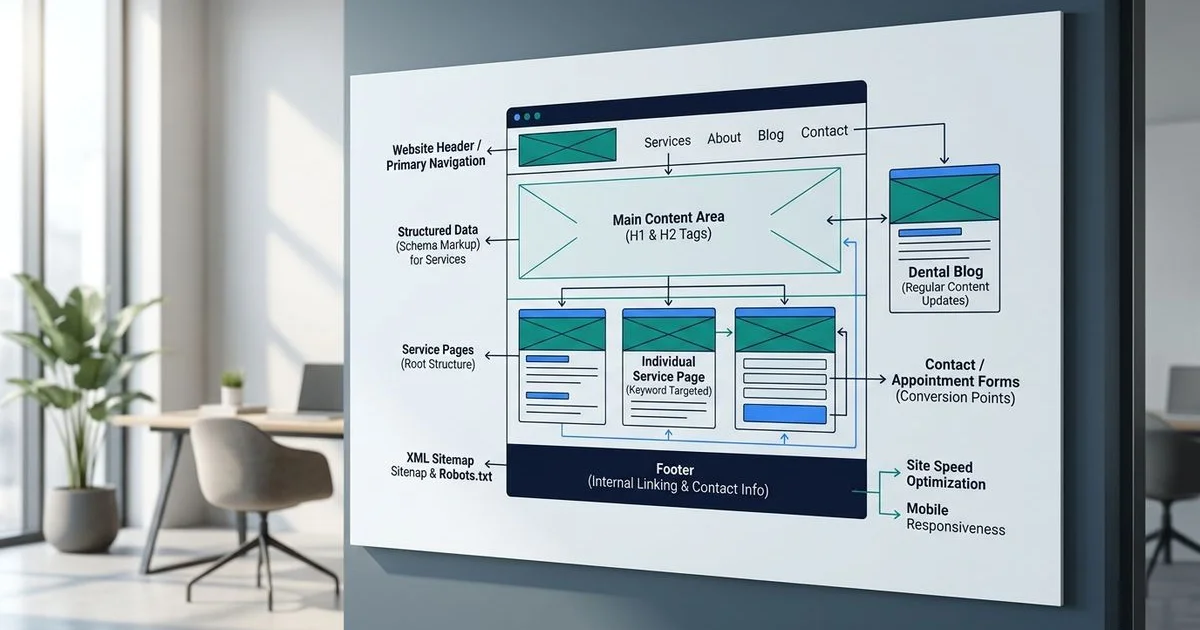
We often see beautiful clinic sites that remain virtually invisible online. The difference between a seo friendly dental website that ranks and one that fails is rarely about visual design. Search visibility relies entirely on the technical foundation running quietly underneath.
Our professional service team focuses on bridging the gap between aesthetic appeal and functional search architecture. A 2026 study by Semrush revealed over 1.2 million monthly US searches for local dentists, proving the stakes are high.
Let’s look at the data, what it actually tells us, and explore how to capture that patient demand.
Clean site structure
We prioritize consistent, hierarchical, and descriptive URL patterns. A path like /services/dental-implants/ is fine, but /page-id-3829?cat=services causes immediate crawl issues. Clear URLs help both Google and local patients understand your site organization.
| URL Structure Type | Example | SEO Impact |
|---|---|---|
| Hierarchical | /services/dental-implants/ | Clear indexation |
| Parameter-Based | /page-id-3829?cat=services | Crawl errors |
Our next step is establishing a logical page hierarchy. Service pages must live under a specific category, just as location pages and blog posts need distinct homes. Each page tells search engines exactly where it sits in your information architecture.
We use header tags like H1, H2, and H3 to form a rigid content outline. Every page gets exactly one H1 for the main topic, H2s for major sections, and H3s for subsections. Using headers purely for visual styling breaks this crucial ranking signal.
Our data shows that poor navigation drastically impacts patient retention. In fact, recent US healthcare metrics indicate bounce rates drop measurably when site structures are intuitive and load quickly. Tools like the Semrush Site Audit can quickly flag these structural dead ends.
Structuring for Patient Intent
We always map site architecture to actual patient search behavior. For example, specific procedure pages convert much faster than generic service lists. This targeted approach ensures every click leads a visitor closer to booking an appointment.
Page speed and Core Web Vitals
We consider loading speed a confirmed ranking factor and a major conversion catalyst. True dental website seo best practices require building lean sites from the start. This means using optimized images, lightweight themes, minimal third-party scripts, and preloaded fonts.
Our target metrics align strictly with Google’s 2026 Core Web Vitals standards. Recent Google data shows that reducing page load time from three seconds to one second can improve conversion rates by up to 27 percent. The specific benchmarks you need to hit include these targets:
- LCP under 2.5 seconds for the largest visible element
- INP under 200 milliseconds to keep the site responsive to taps
- CLS under 0.1 so the page does not jump around as it loads
Our audits reveal that most pre-built dental WordPress themes miss at least two of these out of the box. A custom-built SEO-foundation site passes all three naturally. Fast pages keep local users engaged and prevent them from leaving for a competitor.
Schema markup
We implement Schema as a non-negotiable layer of structured data. This code helps Google understand exactly what your practice does and where it operates. SEO-friendly dental sites rely on several specific markup types:
- LocalBusiness or MedicalBusiness schema for the main practice details
- Service schema for each specific treatment page
- FAQ schema for common patient questions
- Review schema for testimonial sections
- Article schema for blog posts
- BreadcrumbList schema for navigation tracking
Our clients see massive visibility gains when this is done correctly. A recent case study from Sharp Healthcare demonstrated a 119 percent increase in click-through rates just by adding Review Snippets to physician pages. When done right, structured data enables rich results in search and provides clear context for ranking decisions.
| Schema Type | Purpose | Proven Impact |
|---|---|---|
| Review Snippet | Shows star ratings in search | 119% CTR increase (Sharp Healthcare) |
| MedicalBusiness | Defines clinic location and hours | Higher local map pack visibility |
We highly recommend testing your implementation with the Google Rich Results Test tool. Missing fields in your MedicalBusiness code can disqualify you from local map pack enhancements. Proper validation ensures your technical investments actually reach the search engine results page.
Mobile-first design
We optimize for phones because Google uses mobile-first indexing to determine your rank. The mobile version of your site is the only one that truly matters for visibility. A proper design includes responsive layouts, large tap targets for thumbs, and zero horizontal scrolling.
Our research highlights that over 70 percent of health-related searches now happen on mobile devices. Failing mobile usability immediately frustrates your primary audience through specific friction points:
- Microscopic text requiring pinch-to-zoom
- Tiny links placed too close together
- Missing click-to-call functionality
If a patient in pain encounters these issues, they will simply call another clinic.
We track mobile user paths to eliminate friction during emergency searches. Features like sticky contact buttons drastically improve appointment booking rates. Fast, accessible layouts form the baseline for any successful seo dental web design strategy.
Content architecture
We build content architecture so that every service page has entirely unique information. You cannot share 90 percent of your text between general dentistry and family dentistry pages. Location pages must reference real local context, rather than relying on keyword-stuffed boilerplate.
Our approach ensures blog posts naturally link back to commercial service pages. Internal linking concentrates authority directly on the pages that generate revenue. A site with strong content architecture lets every page support the entire domain.
We structure these silos to capture highly specific, high-intent searches. In 2026, Semrush data indicates there are 450,000 monthly US searches for local dentists and 165,000 for emergency dental care. Capturing those users requires localized, highly relevant landing pages.
Avoiding Disconnected Content
We frequently see clinics publishing random blog posts that never tie back to their core offerings. A site without strategic internal linking leaves each page floating and disconnected. Organizing your topics ensures Google crawls and values your expertise efficiently.
Technical foundations
We establish a secure foundation before starting any off-page marketing efforts. Without these baseline technical elements, your website will constantly fight an uphill battle. The core technical requirements include these specific features:
- HTTPS everywhere with valid SSL certificates
- XML sitemaps that include only canonical URLs and stay updated
- Robots.txt configured to allow crawling of critical sections
- Canonical tags preventing duplicate content penalties
- 301 redirects actively managing any URL changes
- No accidental noindex tags hiding important pages
Our engineers check these settings during every routine maintenance cycle. A single misconfigured noindex tag can wipe out thousands of monthly visitors. Each of these is a small thing alone, but together they determine whether your digital strategy succeeds.
How we build SEO-friendly dental sites
Our dental website design service applies a 78-point on-page checklist to every single build. Every site launches with all of the technical foundations fully implemented. As a result, many clinics start ranking for their target keywords within just a few weeks.
We strongly recommend evaluating your existing setup before committing to a totally new platform. If your current site has structural problems, a free 30-point audit will tell you whether fixes can salvage it. For more details on making that choice, see this guide on choosing between a new dental website vs redesign.